
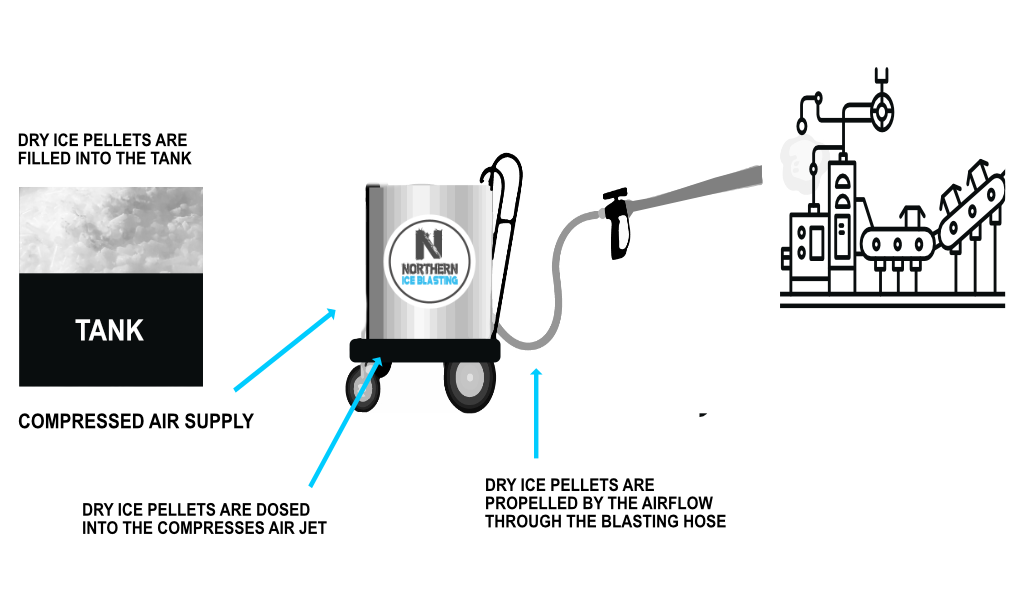
Dry-ice blasting is utilized in many different types of industries. The unique properties of dry ice make it an ideal cleaning solution in many commercial and manufacturing settings:
Food processing industry
Dry-ice blasting can be used to clean food processing equipment. As early as 2004, the UK Food Standards Agency documented the process to effectively decontaminate surfaces of Salmonella enteritidis, E. coli, and Listeria monocytogenes such that these microorganisms are not detectable using conventional microbiological methods. “As a result of two outbreaks salmonellosis associated with the consumption of peanut butter and baby food in 2006-2007, an effort was taken” by GMA members such as Cargill “to reassess industry practices for eliminating salmonella in low-moisture products” because “Salmonella outbreaks from low-moisture products are relatively rare but often impact large numbers of people.”
Historic item preservation
Due to the nonabrasive nature of dry ice and the absence of secondary waste from the cleaning process, dry-ice blasting is used in conservation and historical preservation projects.
Semiconductor fabrication
Due to the blast media sublimating without residue, dry-ice blasting finds use in the semiconductor, aerospace, and medical device manufacturing
Metalworking
The cleaning process is also used in other manufacturing settings, such as cleaning production equipment on automated weld lines, cleaning composite tooling, cleaning industrial printing presses, cleaning molds and equipment used in foundries, and to clean equipment and tooling in onshore and offshore environments in the oil and gas industry.
History
It is believed the US Navy, in 1945, were the first to experiment with dry-ice blasting. They were interested in using the technology for various degreasing applications.
In 1959, Unilever filed a patent for using dry-ice blasting (or water-ice blasting, or some combination of the two) as a method of removing meat from bone.
In 1971, Chemotronics International Inc. filed a patent for using dry-ice blasting for the purposes of deburring and deflashing.
A patent for dry-ice blasting was filed by Lockheed Martin in 1974.
The first patents regarding development and design of modern-day single-hose dry-ice blasting technology were awarded to David Moore of Cold Jet, LLC in 1986, 1988 (U.S. Patent 4,617,064 and U.S. Patent 4,744,181)